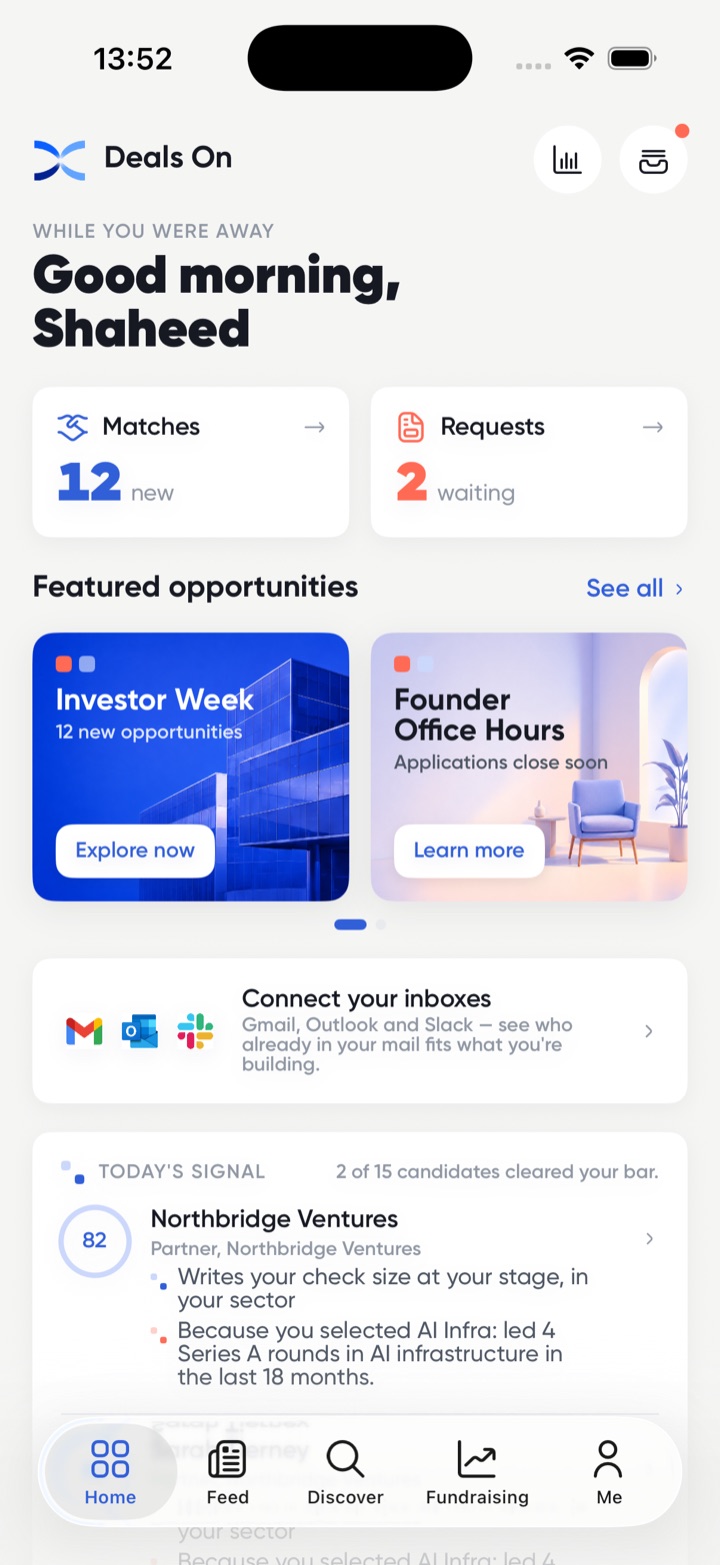
Calendar


Capital, from funds that actually write your cheque
Matched on what they have funded recently, not on what their site says.
Meet the person who can say yes.
Your digital self reads the room and asks the right person for you.
None of it is an effort problem. It’s that the room is invisible — you can’t see who’s in it, who already knows whom, or who is actually moving this month.
Every one of these runs through the same machinery: reach the person who can say yes, with a reason they’ll listen to.
Matched on what they have funded recently, not on what their site says.
Operators with the network, checked for conflicts before you see them.
Warm routes into buying teams, through people who already trust you.
People whose stage, skills and appetite match where you actually are.
Employers post a real opening with its constraints; candidates declare what they want next. The match is on intent, both ways.
Rooms where being early is not disqualifying. Find a cofounder, a mentor who has done this exact thing, or the first person willing to back it.
Capital, design partners, a first enterprise customer, a senior hire — ranked on evidence and reached through people who already trust you.
Deal flow against your live thesis rather than your website, with portfolio conflicts removed before a name ever reaches you.
Run office hours as an open lane. Applications arrive summarised, with the question they actually need answered — and you decide, never the model.
Partnerships, pilots and distribution — surfaced to the companies that need exactly the network you spent years building.
Run a program as a channel: set the access policy, publish the lane, and review every application in one inbox instead of a shared mailbox.
Put your builders in front of investors, mentors and employers, with the cohort’s applications and outcomes in one place.
Publish an event, gate it with a policy, and let the people who qualify apply — instead of a guest list you chase by hand.
A company as a counterparty: the partnership, the pilot customer, the cofounder for a new line — matched on what you are trying to do this quarter, not your About page.
Post the role with its real constraints — level, stack, location, timing — and meet the people who declared they want exactly that, instead of screening a pile of CVs.
Say what you want next and where. Openings that fit find you, through people who can vouch — and nobody sees you are looking unless you choose.
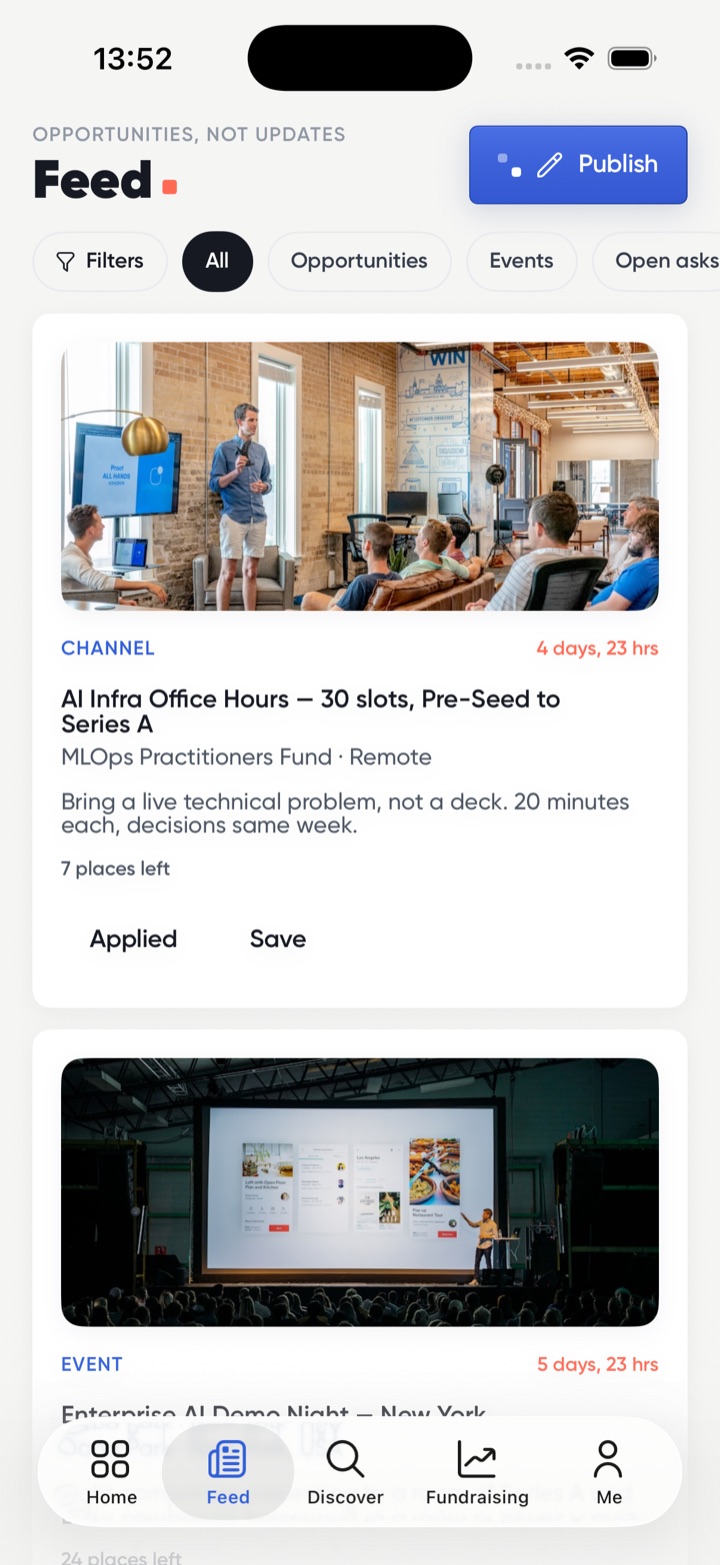
What an accelerator, a university or an event host puts into the room: a policy, a capacity, and a deadline that counts down in public.
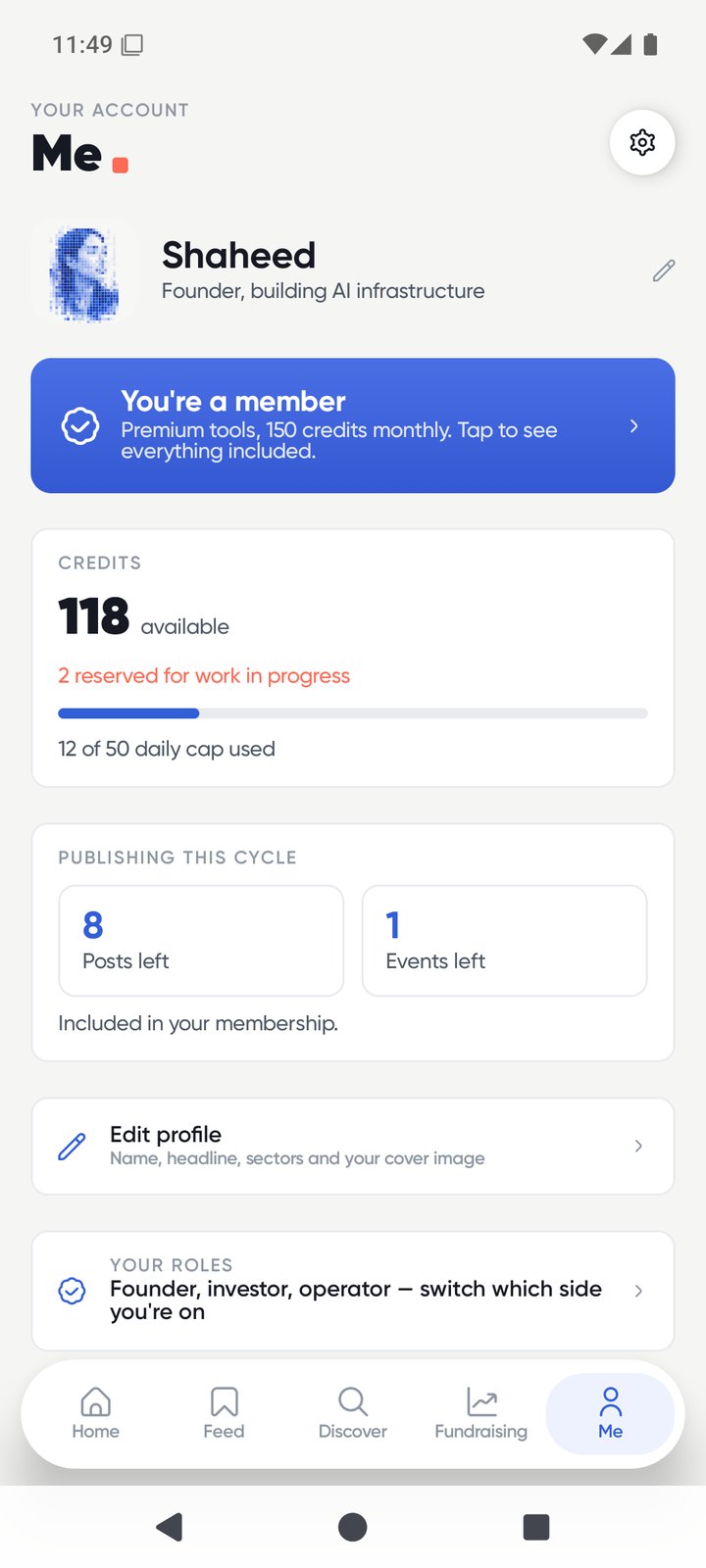
Your profile, your credits and what you are allowed to publish this cycle sit in one place — not one account per hat you wear.
Both are matching problems disguised as volume problems. An opening and a person looking for one are two intents that fit — or don’t — on exactly the same evidence capital is matched on.
Level, stack, location, start date, budget, what you will not consider. Expiry included — a role that closed stops matching, instead of collecting applications forever.
Role, seniority, sectors, cities, remote or not, earliest start. Visible only to employers whose opening fits — never a public "open to work" badge your current employer can see.
The introduction travels along a real relationship path — a former colleague, an investor, a mentor — with the evidence attached. No cold applications, no cold outreach.
Pick Hiring company or Looking for a role when you start — or add either to a role you already hold.
A feed, a job board and a cold message all put the work back on you: scroll, post, guess, wait. The difference is what happens before you ever open the app.
 LINKEDIN,
Endless scrolling and a connect button, with no way to know whether that person can actually say yes to anything you need.
 JOB BOARDS,
A posting matches a résumé once, at the moment you happen to look. Nothing routes a warm path in, and nothing keeps working after you close the tab.
The agent walks the graph every night, checks who is actually reachable, and has the ask ready with the evidence attached by the time you sit down.
You do the last one. The rest runs whether you are watching or not.
Email, LinkedIn, Slack, the application you filed last week — one inbox, one thread per relationship, worked in the background without being asked.
No more five tabs and a spreadsheet.
Before you write a word it builds a picture of the person on the other side: what they have backed, how they decide, what they already asked you for.
You stop guessing what to lead with.
The right ask, with the evidence attached, sent down a path that is actually open to you. Then it chases the follow-up so a yes does not die in someone’s inbox.
No more waiting on a reply that never comes.
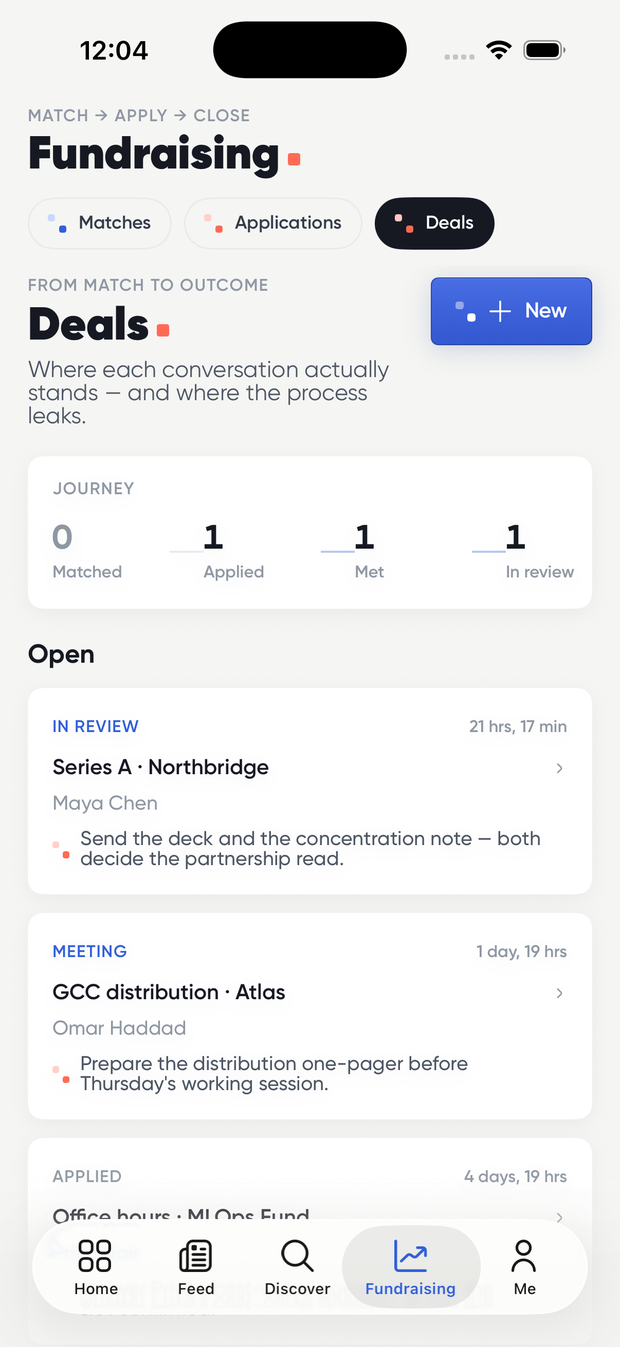
Matched, applied, met, agreed — tracked end to end so you always know whose turn it is. The last step is yours. That part should not be automated.
One place to see every deal you have open.
A fund, an open lane and a company can sit in the same list. Each row carries the reason it surfaced and the concern next to it. Nothing here is a mystery score.
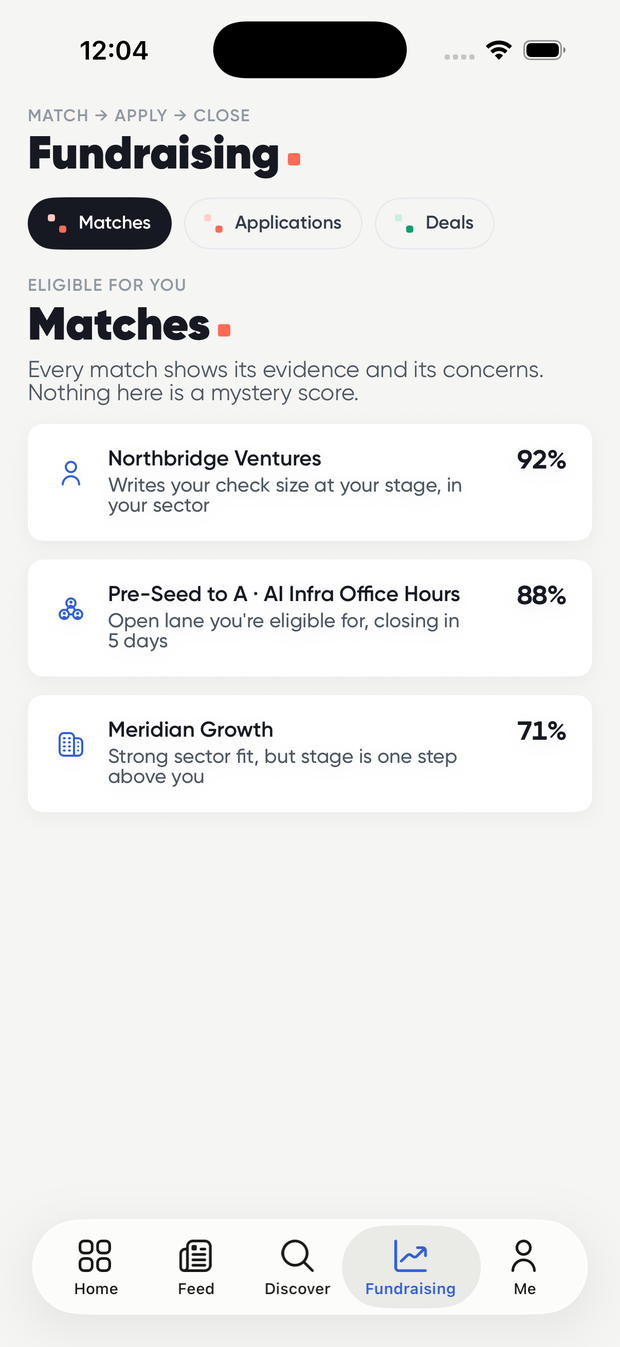
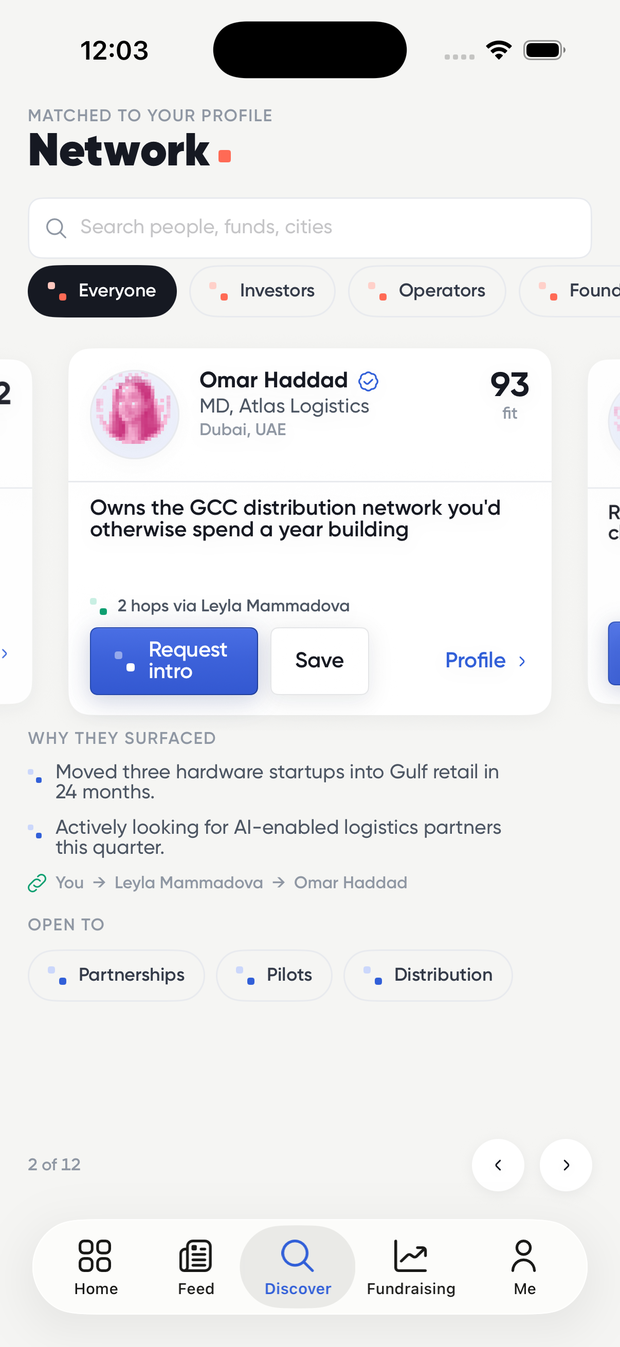
Filter the room by what someone is — investors, operators, mentors, founders — and see why they surfaced, what they are open to, and the people standing between you.
Where each conversation actually stands, and where the process leaks. A round, a distribution deal and an office-hours application run on the same stages, so you always know whose turn it is.
The graph finds the person your target already trusts and routes the introduction through them. If it is not confident those two actually know each other, the path is not shown.
Every match resolves through an ontology of roles, sectors and stages — the same graph you just saw — not a language model’s improvisation. It reads more of how you actually work with every connection you make, and gets sharper because of it. It decides nothing on your behalf; the only thing it decides for itself is what to bring you next.

Connects to your inbox and conversations, resolves who you actually talk to, and builds a real picture of how you work — read-only, nothing leaves your view.

Every match is scored against your ontology of roles, sectors and stages, re-ranked as new evidence comes in — grounded in fact, never guessed.

Shows who can introduce you, with the evidence attached. You write and send every message yourself.
Walks the graph against your declared intent and ranks who clears the bar — not a keyword search over a pile of profiles.



Connect Gmail, Outlook or Slack and it resolves who you actually talk to — read-only, and nothing it reads leaves your view.


The graph routes the introduction through someone your target already trusts — no confidence, no path shown.
One cycle, minute by minute. Anything it finds waits at the morning edge — a 2am result is the same result at 8am, minus the resentment.
Be free.
I’ll care.
Founders, investors, mentors, operators, the accelerator running the cohort — scored on evidence, identity-checked, and reachable through people who already trust you.
“Show me your opportunity.”
A round, a pilot, a cofounder, a cohort — whatever you are trying to make happen, your digital self walks up to the person who can say yes, with your evidence in hand.Start free →Matched
Applied
In review
Intro
Meeting
Follow-up
Outcome
Closing records what happened — landed or not, and why. It stays in your history either way.
An opportunity channel is a lane with a policy — role, stage, sector, region, verification, profile completeness. Eligibility is checked on the server before you can apply, so you are never sitting in a room that was always going to say no. When you do not qualify, you are told which requirement missed, and shown the lanes you do qualify for.

Office hours, a pipeline review, a program intake, a demo night — each with its own rules, capacity and a deadline that is real.
Before you submit, you see the exact payload the reviewer receives. Private notes and your other applications never travel with it.
Every claim on a match resolves to a fact the system can show you. If the written explanation is unavailable, the structured evidence still stands.
The agent finds and ranks, then stops. Every outbound action waits for an explicit tap, and you set how much latitude it has — observe, assist, or act only with confirmation.
Connect Gmail, Outlook or Slack and it resolves who you talk to and what was asked. It never sends as you, raw messages never leave your view, and disconnecting deletes the derived data.
Membership buys tools and capacity — never fit, trust, verification or eligibility for a lane. Badges come from outcomes that actually happened, and they cannot be bought either.
You answer the questions once. What comes out of them is a version of you that knows which door is worth knocking on, and can do the reading, the ranking and the checking while you get on with the work itself.
It reads the room you’re not in.
It shows you the way in, with the facts behind it.
It never sends without your word.
You keep the last move.
Roles, the outcome you want, the evidence behind it. Two minutes, and no CV.
Every match carries the evidence it was ranked on and the concern next to it. Nothing is a mystery score.
The graph routes the introduction through someone your target already trusts. No path, no claim.
Your agent sends nothing on your behalf. You approve the words, and the context travels with them.
The deal opens on a board with seven states, so you always know whose turn it is.
Outcomes are recorded either way. That record is what later badges are earned from; none of them can be bought.
Browse, apply, accept intros and track every deal you open. Fifteen new people a day.
See what’s includedThe network without the daily cap, full evidence and relationship paths, 3 Deal Links, and 40 agent credits a month. 7-day free trial.
Start 7-day free trialApplying to a channel, accepting an intro, updating a deal, reporting or blocking and managing your account never cost credits — with or without membership. Credits pay for the deeper analysis your agent runs on top. Billed through the App Store; cancel any time.
Yes. Pick every role that is true — founder and mentor, investor and operator — and switch your active mode whenever you like. It is one account, and your history follows you across modes.

Pick the roles that are true, name the outcome you want, and see what is actually open to you. Browsing, applying and accepting intros are free.


Not on either store yet. These become real download links the day the apps ship — until then the web app is the whole product, and it is open now.